Economies are choices. What will you choose?
We support the design of local economies that put people and planet first.
- Simulation models as thinking tools for your community, built on complexity economics.
- Science fiction narratives to render economic policies into people's daily lives.
- Participatory tools and techniques for economic democracy and policy design.
Courier
Every day, you walk the streets and try to find a logic in what you see. Need in the midst of glut. Relentless destruction of the global natural resources that keep us alive. Hot money slashing around the world’s financial markets, creating wealth without material benefits. Everywhere, that unwillingness to face the facts.
You have been told that yes, there are imbalances and market failures, but There Is No Alternative.
But you cannot quite bring yourself to believe it.
We are the Science Fiction Economics Lab, and we feel like that, too. Let us help. After all, if the system fails us . . . why shouldn't we build back better?
You decide
One budget, five claims
The town now
Follow the change
Outside your control
How this works
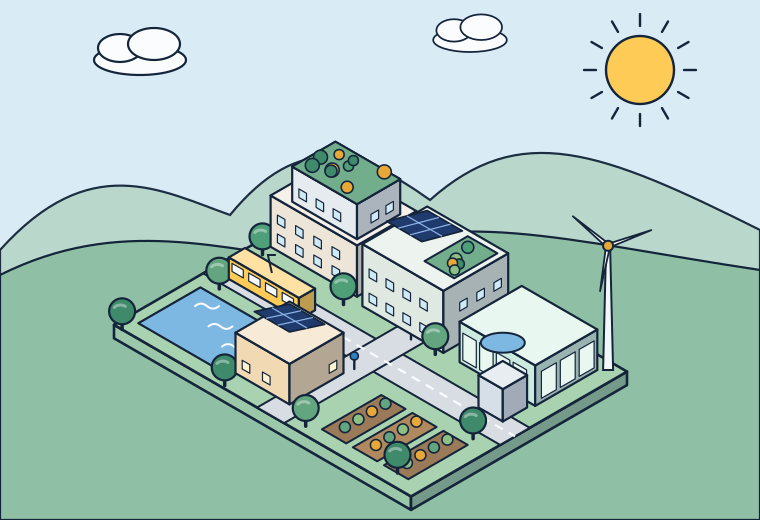
Linden Cove is a toy model of a small town economy with twelve causal links: rent, tax and a shared budget on one side, weather and markets on the other. Its purpose is not realism, but to show how simulation models can help interpret different policy choices.
- Higher rent moves money from workers to owners, who spend less of it in town, so shops sell less.
- Higher rent also lowers what workers keep, so fewer people move in and some leave.
- Rent above 30 draws builders in. Rent below 30 slowly starves the housing stock, so cheap rent first fills the town and then crowds it.
- Higher income tax lowers take-home pay at once and funds services slowly.
- Education works slowest, with a half-life of about 69 months, and lifts wages the most.
- Infrastructure keeps output per worker up, and it is what storms damage.
- Health and care keeps output per worker up at a smaller effect.
- Justice cuts business overhead and makes the town safer to run a shop in.
- Public transport lets the unemployed find jobs faster and helps exports.
- Rain, sun and storms change how much the town can produce and sell.
- A ship that leaves takes a slice of export demand with it for about a year.
- More people dilute the budget per household, so growth is not free.
The mood number combines three things: what people keep after tax and rent (weight 0.4), how many have work (0.3) and how good the public services are (0.3), minus a penalty when there are more households than homes.
The Linden Cove model is a teaching device. We can model your regions, your towns, and help you explore the future of both present and alternate economics.



Our process is called generative ethnography: complexity economic theory, speculative futures thinking and inclusive community-building, working together.
Places, models and stories we have built
Real places, real plans and invented futures. Each one says what we did and what it showed, and links to the original.
One Planet, One Humanity webinars
Four global webinars, from 19 November 2026 to 22 January 2027, on climate, population, political change and a new economy, with interpretation in English, Spanish and Italian and a science fiction contribution to each.
Sci-fi economics wiki and the scifigraph extractor
A community wiki of economically minded science fiction, turned by an LLM extractor into a network of 25 works and 135 economic concepts.
The Great Retrofit world
A near-future Messina written up as if from 2050: a ten-year plan to retrofit 60,000 homes, with the financing, the rent cap and the cooperative that does the work all spelled out.
Sci-Fi Economics at ASU
A public workshop at Arizona State University on using speculative fiction to imagine alternative economic futures.
The Colombo That Might Have Been
A near one-to-one replica of Colombo, with over a million virtual citizens, built in Cities: Skylines to test the first two phases of a 2.78 trillion rupee transport plan before anyone builds it.
Science Fiction Economics Residency in Messina
Four days near Messina in May 2024 in which policymakers, economists and writers built a post-neoclassical economy as a published encyclopedia entry and a story.
A Town by the Sea
An online role-play map-building game in the world of Witness, played in groups of five, built in about a month within the Playful Futures project.
Watchdog relaunches as an open-source collective
Watchdog, a fact-checking app, became an open-source intelligence collective with funding from OCCRP and mapped the 2022 protests.
Witness
An open-source seasteading megacity of twelve Distrikts, a card game about governing imaginary societies through crises, and the 2024 Witnesspedia.
Messina papers and the Worldbuilding Academy
A documented case of a Sicilian foundation that built about 120 enterprises around social goals, plus the launch of an open-source academy where writers and economists imagine the future of economics.
The Lab is prototyped and launched
The Lab was prototyped and launched at a public event in Brussels with Cory Doctorow, followed by funding from EIT Climate-KIC in 2020.
A short family tree
Economists, city thinkers, game designers and writers whose ideas we build on.
Let's work together!
School of Complexity Economics
With our partners and allies we organize a School of Complexity Economics for Place-Based Human Development. Expect bold economic ideas. And science fiction.
Leadership retreats
A few days for a council or ministry to run the model of its own problem and live in the story.
Research participation
Partner with us on participatory research projects. Bring to your inquiry rapid simulation modelling, large-scale ethnography and science fiction narrative to explore alternative futures.
Workshops
Economists and writers in one room, building a scenario for a place from its own data. In Messina in 2024, policymakers, economists and writers spent four days building a near-future economy for the city, and one group published a costed plan to retrofit 60,000 homes.